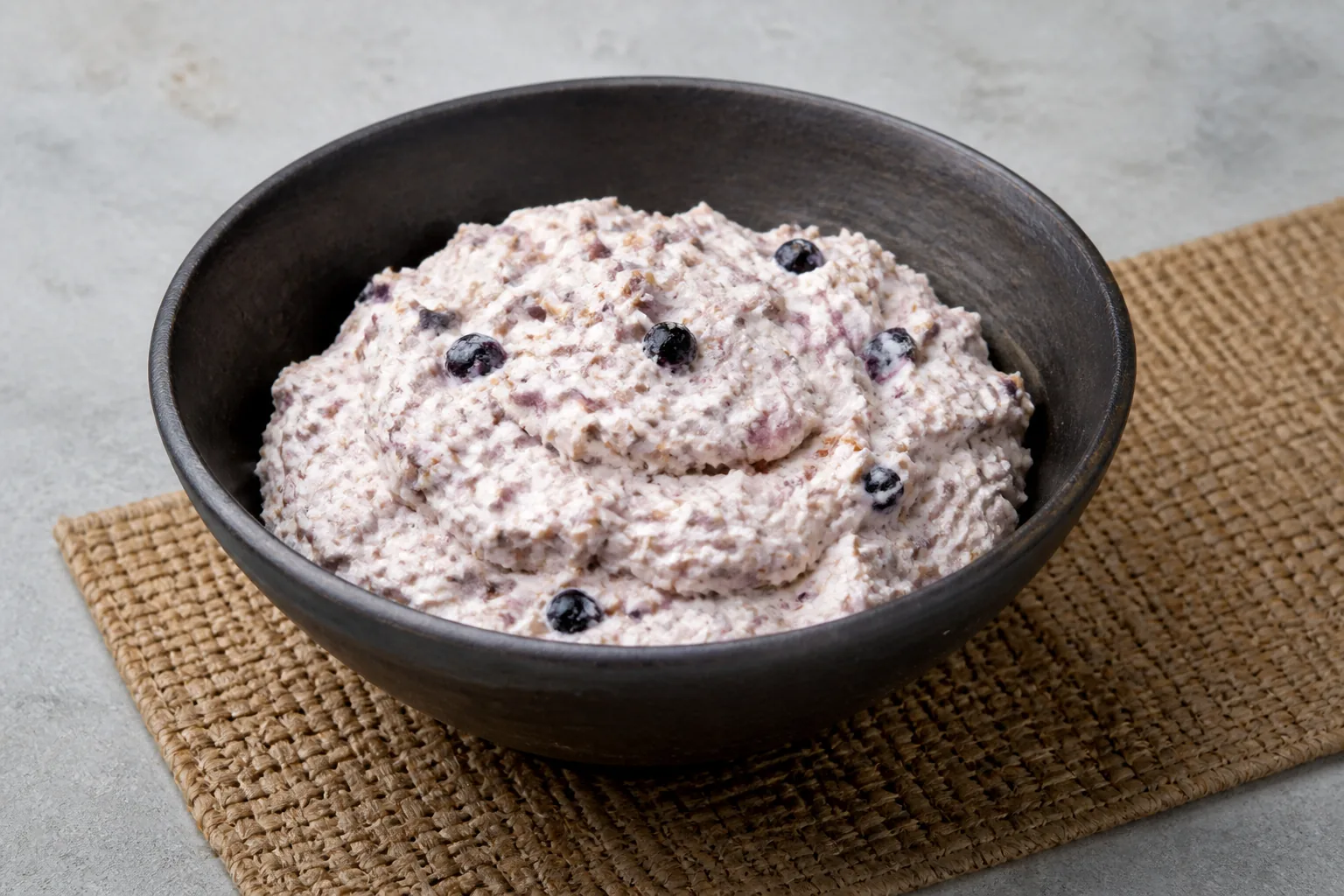
QUICK ANSWER
How many calories are in agutuk?
The selected USDA fish-and-berry agutuk record contains 353 calories per 100 g. Its 31.8 g of fat is the main reason it is energy-dense; agutuk recipes vary widely, so use this number only for a close ingredient match.
353 kcal / 100 gNutrition values describe a reference food state, not every individual item. Variety, water content, preparation and portion weight can change the estimate.
THE NUMBERS
Agutuk nutrition facts per 100 g
The table below uses the reference state shown at the top of this page. Keeping one gram basis makes it easier to compare foods before translating the values to the portion you actually ate.
Source: USDA FoodData Central SR Legacy record 168976. Values may be rounded for readability.
SERVING SIZE
Calories by portion and serving weight
Words such as “small,” “medium,” “half” and “one piece” are convenient but imprecise. Grams make the estimate reproducible, particularly when natural foods vary in size.
MACROS
Carbohydrate, protein and fat explained
Fat
The selected seal-oil recipe contains 31.8 g per 100 g, making fat the dominant energy source.
Carbohydrate
USDA reports 13.4 g per 100 g; berries and any added sugar change this amount across recipes.
Protein
The fish-and-berry composite supplies 3.4 g per 100 g, but fish quantity differs among preparations.
MORE THAN CALORIES
Fibre, vitamins and minerals
One food does not need to provide every nutrient. These are the characteristics most useful for understanding where agutuk fits in a varied eating pattern.
Vitamin E
The record lists 2.36 mg per 100 g.
Phosphorus
USDA reports 46 mg per 100 g.
Fibre
The selected recipe contains 0.5 g per 100 g; berry type and quantity can shift this.
Water
At 47.3 g per 100 g, this composite is much less water-rich than fresh fruit, helping explain its calorie density.
FOOD STATE MATTERS
How preparation changes the nutrition estimate
A reliable calorie entry should describe the food you actually ate—not merely a food with a similar name.
Fish, berries and seal oil
This is the exact selected USDA state.
Meat-caribou agutuk
USDA holds a separate record; do not combine it with the fish-and-berry value.
Fish with shortening
Shortening-based versions have their own ingredient and fat profile.
Family and regional recipes
Names, fats, fish, berries and sugar differ among Athabascan, Yup'ik and Iñupiaq preparations; calculate the known recipe when possible.
PRACTICAL CONTEXT
How agutuk can fit different goals
There is no universal “good” or “bad” food. Portion, frequency, the rest of the meal, preferences and individual health needs all matter.
High-energy food
The selected recipe provides 353 kcal per 100 g and is energy-dense because of its fat content.
Cultural context
Agutuk is a living traditional food shared across multiple Alaska Native cultures, not simply a generic dessert.
Portion tracking
A small visual scoop can vary considerably; grams are more reliable.
Recipe accuracy
Seal oil, tallow, shortening, fish, meat, berry and sugar choices can materially change the result.
QUALITY & SAFETY
How to choose, store and prepare it
Traditional preparation
Use community knowledge and the actual ingredient sources for safe handling; this nutrition record is not a preservation guide.
Fish and animal fat
Keep ingredients appropriately cold and prevent cross-contamination during preparation.
Finished dish
Refrigerate or freeze promptly according to the recipe and ingredient guidance.
Thawing
Thaw under refrigeration and avoid repeated long periods at room temperature.
PHOTO LOGGING
How to log agutuk more accurately
A food photo can suggest the ingredient, but it cannot always reveal exact weight, hidden oil or preparation details. These checks turn an image guess into a better estimate.
- 01
Confirm whether the recipe used fish and berries with seal oil.
- 02
Weigh the actual serving; the USDA record has no household portion measure.
- 03
Use separate records for meat-caribou or shortening versions.
- 04
When ingredients and finished yield are known, a recipe calculation is more accurate than the composite.
COMMON QUESTIONS
Agutuk calorie and nutrition questions
How many calories are in fish-and-berry agutuk?
The selected USDA record lists 353 calories per 100 g.
Why is agutuk high in calories?
The selected recipe contains 31.8 g of fat per 100 g, largely reflecting its seal-oil base.
Is agutuk always made the same way?
No. UAA documents variation across cultures and recipes, including different traditional fats, fish, meats and berries.
Is agutuk the same as commercial ice cream?
No. The English nickname does not make the ingredients or nutrition equivalent to dairy ice cream.
Why are portions shown only in grams?
The selected USDA record has no household serving measure, so a cup or scoop weight would be invented.
KEEP EXPLORING
Related food guides
SOURCES & METHOD
Where these numbers come from
Values describe Agutuk, fish/berry with seal oil (Alaskan ice cream) (Alaska Native), per 100 g. Other traditional and modern versions require their own recipe or matching record.
Open USDA FoodData Central SR Legacy record 168976 ↗Used for Indigenous terminology, cultural context, ingredient variation and traditional-fat distinctions.
Page reviewed 26 August 2026. We show the food state, gram basis and source record so readers can check the estimate instead of treating one number as universally exact.